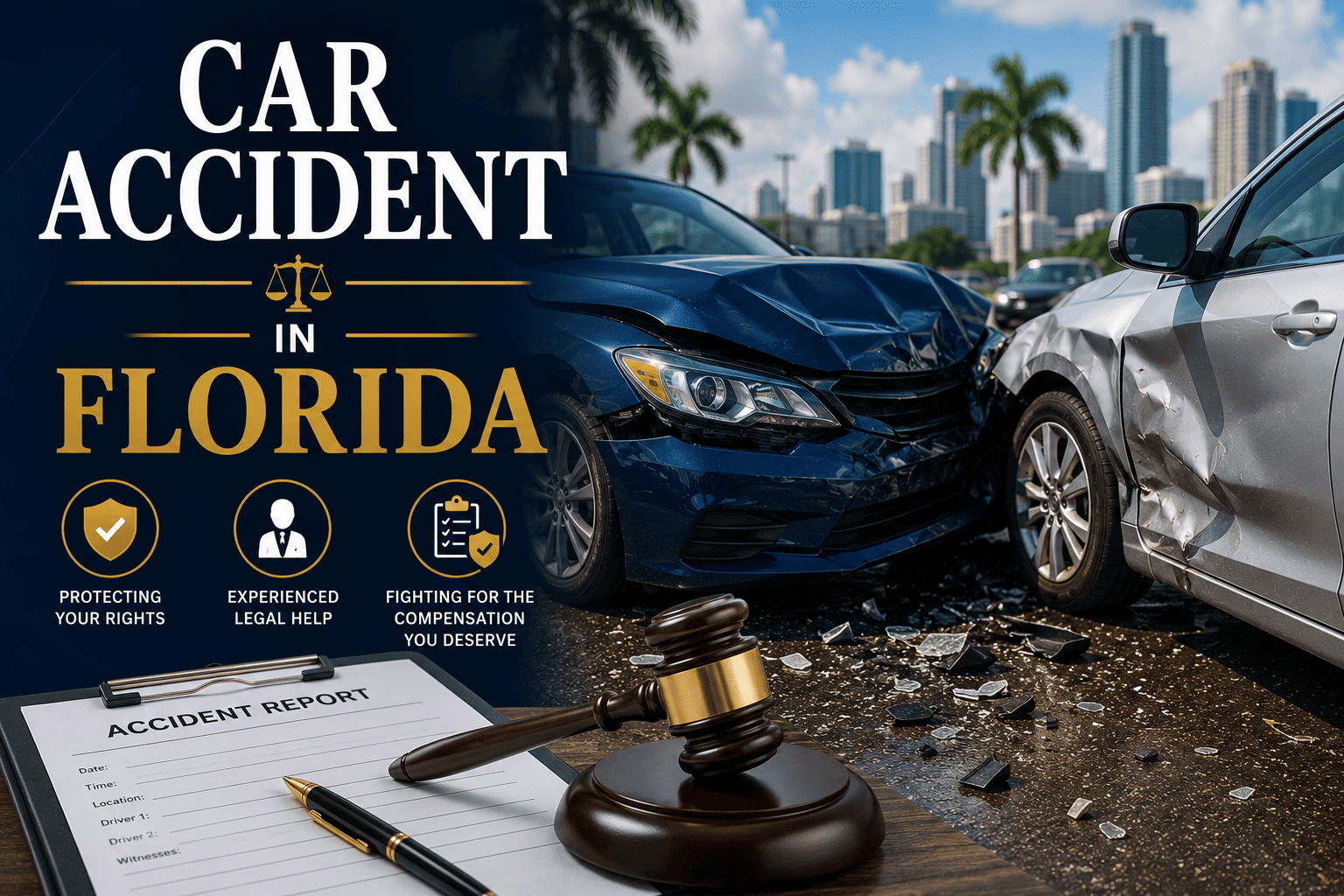
A car accident can happen without warning, leaving you overwhelmed, confused, and unsure of what to do next. Whether the collision is minor or severe, the decisions you make immediately afterward can significantly affect your health, insurance claim, and ability to recover compensation.
Knowing the proper steps after a crash can help protect your legal rights and strengthen your personal injury claim. If you suffered injuries caused by another driver’s negligence, speaking with an experienced Florida car accident lawyer can help you understand your available legal options.
1. Check Yourself and Your Passengers for Injuries
Your safety should always be your first priority. Check yourself and your passengers for visible injuries, pain, dizziness, confusion, or difficulty moving.
If anyone appears to be injured:
- Call 911 immediately.
- Request emergency medical assistance.
- Remain in a safe location whenever possible.
- Avoid moving anyone with a serious injury unless remaining in place creates an immediate danger.
Adrenaline can temporarily hide pain and other symptoms. A person may feel relatively normal immediately after a collision and begin experiencing symptoms several hours or days later.
2. Move to a Safe Location When Possible
If the vehicles can be moved safely, move them away from active traffic. Turn on your hazard lights and remain aware of approaching vehicles.
If moving a vehicle would be unsafe or someone has suffered a serious injury, wait for emergency personnel and follow their instructions.
3. Contact Law Enforcement
Contact the appropriate law enforcement agency and report the collision. Depending on the location, the responding agency may be a city police department, county sheriff’s office, or the Florida Highway Patrol.
A responding officer may:
- Secure the accident scene.
- Speak with the drivers and witnesses.
- Document vehicle damage.
- Record road, traffic, and weather conditions.
- Prepare an official crash report.
- Issue citations when appropriate.
An official crash report may become important evidence during an insurance claim or personal injury lawsuit.
Information about Florida traffic crashes and driver responsibilities is available through the Florida Department of Highway Safety and Motor Vehicles.
4. Exchange Information With the Other Driver
Exchange identifying and insurance information with every driver involved in the collision.
Try to collect the following:
- Driver’s full name.
- Driver’s license information.
- Home address and telephone number.
- Insurance company name.
- Insurance policy number.
- Vehicle make, model, and color.
- License plate number.
- Name of the registered vehicle owner.
Remain calm and avoid arguing about who caused the accident. Do not admit fault or make statements about responsibility before the incident has been fully investigated.
5. Photograph and Record the Accident Scene
Evidence can disappear quickly after a collision. Vehicles may be moved, damaged property may be repaired, surveillance recordings may be erased, and road conditions may change.
When it is safe and you are physically able, take photographs and videos of:
- Damage to every vehicle involved.
- The final resting positions of the vehicles.
- Skid marks and debris.
- Traffic signals and signs.
- Lane markings and intersections.
- Weather and lighting conditions.
- Nearby businesses or security cameras.
- Visible physical injuries.
Take wide photographs showing the entire scene as well as close-up photographs of specific damage.
6. Collect Witness Contact Information
Independent witnesses may provide valuable information about how the accident happened. Witness testimony can be especially important when drivers provide conflicting versions of events.
Ask witnesses for their:
- Full name.
- Telephone number.
- Email address.
- Brief description of what they observed.
Do not rely solely on the investigating officer to identify every available witness.
7. Seek Medical Treatment as Soon as Possible
One of the most important steps after an accident is obtaining an appropriate medical evaluation. Some accident-related injuries do not immediately produce obvious symptoms.
Delayed symptoms may be associated with injuries such as:
- Whiplash and other soft-tissue injuries.
- Concussions and traumatic brain injuries.
- Herniated or damaged spinal discs.
- Internal bleeding.
- Back and neck injuries.
- Nerve damage.
- Joint and ligament injuries.
Prompt treatment protects your health and creates medical documentation connecting your injuries to the collision.
Information about motor vehicle safety and accident prevention is available from the National Highway Traffic Safety Administration.
8. Follow Your Doctor’s Treatment Instructions
Attend scheduled appointments and follow the treatment recommendations provided by your medical professionals. This may include:
- Diagnostic imaging.
- Physical therapy.
- Specialist appointments.
- Prescription medication.
- Activity restrictions.
- Follow-up examinations.
Missing appointments or ending treatment before being medically released may affect your recovery and give an insurance company an opportunity to argue that your injuries were not serious.
9. Notify Your Insurance Company
Report the collision to your insurance company promptly. Provide the basic facts of the accident, but avoid guessing about matters you do not know.
When communicating with an insurance company:
- Do not speculate about the cause of the crash.
- Do not minimize your injuries.
- Do not admit fault.
- Do not sign documents you do not understand.
- Avoid providing a recorded statement to another driver’s insurer before obtaining legal advice.
Insurance adjusters may contact you quickly after an accident. Their job is to investigate the claim and protect the financial interests of the insurance company.
10. Keep Copies of All Accident-Related Records
Create a physical or digital file containing all documents connected to the collision.
Important records may include:
- The police crash report.
- Photographs and videos.
- Medical records.
- Hospital and physician bills.
- Prescription receipts.
- Vehicle repair estimates.
- Towing and storage invoices.
- Rental car expenses.
- Insurance correspondence.
- Proof of lost wages.
These records can help establish the financial and personal impact of the accident.
11. Document Your Symptoms and Recovery
Consider keeping a daily journal describing your symptoms and how the injuries affect your normal activities.
You may document:
- Pain levels.
- Sleep difficulties.
- Medication side effects.
- Missed work.
- Mobility limitations.
- Missed family activities.
- Emotional distress.
A recovery journal can provide important details that may be difficult to remember several months later.
12. Avoid Discussing the Accident on Social Media
Insurance companies and defense attorneys may review publicly available social media activity. Photographs, comments, location check-ins, and videos may be taken out of context and used to challenge your claim.
Avoid posting information about:
- The accident.
- Your physical condition.
- Your medical treatment.
- The other driver.
- Insurance negotiations.
- Potential settlement amounts.
You should also ask friends and family members not to post photographs or information about you while your claim is pending.
13. Do Not Accept a Quick Settlement Without Reviewing Your Losses
An insurance company may offer a settlement shortly after the accident. Early settlement offers may arrive before the full extent of your injuries, future treatment needs, and lost earning capacity are known.
Before accepting an offer, consider whether it accounts for:
- Past medical expenses.
- Future medical treatment.
- Lost wages.
- Reduced future earning ability.
- Pain and suffering.
- Permanent disability.
- Vehicle and property damage.
A signed settlement agreement usually ends your ability to request additional compensation later.
14. Understand Florida’s No-Fault Insurance System
Florida operates under a no-fault automobile insurance system. After many accidents, an injured person initially seeks certain medical and lost-wage benefits through their own Personal Injury Protection coverage.
Depending on the seriousness of the injuries and the circumstances of the crash, an injured person may also be able to pursue a claim against the at-fault driver.
Because insurance coverage questions can become complicated, especially when multiple vehicles or policies are involved, consider speaking with a lawyer who handles Florida auto accident claims.
15. Understand Florida’s Comparative Negligence Rules
Insurance companies may attempt to argue that an injured person was partially or completely responsible for a collision. The percentage of fault assigned to each party can affect the compensation that may be recovered.
Evidence used to evaluate fault may include:
- Police reports.
- Witness statements.
- Surveillance recordings.
- Dash-camera footage.
- Vehicle damage.
- Electronic vehicle data.
- Cellphone records.
- Accident reconstruction evidence.
A personal injury attorney can investigate the crash and respond to unsupported attempts to shift blame.
When a Car Accident Involves an Uber or Lyft
Rideshare accidents may involve additional insurance questions. The available coverage can depend on whether the driver was:
- Logged out of the rideshare application.
- Logged in and waiting for a ride request.
- Traveling to pick up a passenger.
- Transporting a passenger.
Learn more about claims involving Uber and Lyft drivers by visiting our Miami rideshare accident lawyers page.
When a Commercial Truck Is Involved
Truck accidents may involve trucking companies, commercial insurance carriers, maintenance contractors, cargo-loading businesses, and other responsible parties.
Commercial vehicles may also contain important evidence, including driver logs, inspection records, maintenance documentation, onboard electronic data, and company safety records.
Visit our truck accident claims page to learn more.
Common Injuries Caused by Florida Car Accidents
Motor vehicle collisions can cause injuries ranging from temporary discomfort to permanent disability.
Common accident-related injuries include:
- Neck and back injuries.
- Whiplash.
- Broken bones.
- Traumatic brain injuries.
- Spinal cord injuries.
- Internal organ damage.
- Burns and lacerations.
- Knee and shoulder injuries.
- Nerve damage.
- Psychological trauma.
When negligent medical treatment makes an injury worse, separate issues involving medical malpractice may need to be evaluated.
What Compensation May Be Available After a Car Accident?
The compensation available depends on the facts of the collision, available insurance coverage, the seriousness of the injuries, and the effect the accident has had on the injured person’s life.
Potential damages may include:
- Emergency medical treatment.
- Hospital expenses.
- Physical therapy and rehabilitation.
- Future medical care.
- Lost wages.
- Reduced earning capacity.
- Pain and suffering.
- Disability or disfigurement.
- Property damage.
- Loss of enjoyment of life.
Families who lose a loved one in a fatal collision may have rights under Florida law. Visit our wrongful death claims page for additional information.
How a Florida Personal Injury Lawyer Can Help
Insurance companies begin investigating collisions quickly. Having legal representation can help ensure that someone is also working to protect your interests.
A personal injury lawyer may:
- Investigate the accident scene.
- Obtain police and medical records.
- Locate and interview witnesses.
- Request surveillance or dash-camera footage.
- Review available insurance coverage.
- Document medical expenses and lost income.
- Communicate with insurance adjusters.
- Negotiate for a fair settlement.
- Prepare and file a lawsuit when necessary.
Learn more about the firm’s services on our Miami personal injury practice areas page.
Frequently Asked Questions About Florida Car Accidents
Should I seek medical attention if I feel fine?
Yes. Some injuries do not immediately produce noticeable symptoms. A prompt medical examination can help identify hidden injuries and create documentation connecting those injuries to the accident.
Should I admit fault at the accident scene?
No. Provide truthful information to law enforcement, but avoid admitting fault or speculating about the cause of the collision. Fault should be evaluated after all available evidence has been reviewed.
Should I speak with the other driver’s insurance company?
You should be cautious when communicating with another driver’s insurer. The company may request a recorded statement or ask questions designed to limit its responsibility. Consider obtaining legal advice before giving a detailed statement.
What happens if the other driver does not have insurance?
You may have potential coverage through your own insurance policy, including uninsured or underinsured motorist coverage. An attorney can review the policies and determine what coverage may be available.
Can I recover compensation if I was partly responsible?
Partial responsibility may affect the amount of compensation available. The outcome depends on the facts of the case and the percentage of fault assigned to each party.
How long does a car accident claim take?
The timeline varies depending on the seriousness of the injuries, the length of medical treatment, disputed liability, available insurance coverage, and whether litigation becomes necessary.
When should I contact a personal injury attorney?
Contacting an attorney promptly may help preserve evidence, identify applicable deadlines, and prevent avoidable mistakes during the insurance claim process.
Contact Lopez Fernandez Personal Injury Lawyers
If you or someone you love suffered injuries in a Florida car accident, Lopez Fernandez Personal Injury Lawyers can review the circumstances and explain your legal options.
Our firm represents people injured in car crashes, rideshare collisions, truck accidents, unsafe property incidents, and other negligence-related cases.