After suffering an injury in Florida, you may need time to obtain medical treatment, understand the extent of your losses, and determine who was responsible. However, the law does not allow an injured person unlimited time to file a lawsuit.
Florida establishes legal filing deadlines known as statutes of limitations. Missing the applicable deadline may prevent you from recovering compensation, even when strong evidence shows that another person or company caused your injuries.
The deadline is not necessarily the same for every case. It may depend on the type of accident, when it occurred, whether medical negligence was involved, whether the claim is against a government entity, and whether an exception applies.
An experienced Florida personal injury lawyer can review the circumstances of your case, identify the applicable deadline, preserve important evidence, and take the necessary legal steps before time expires.
What Is a Statute of Limitations?
A statute of limitations is a law that establishes how long a person has to begin a legal action. In a personal injury case, this generally means the deadline for filing a lawsuit in the appropriate court.
The purpose of a filing deadline is to encourage legal disputes to be addressed while evidence is still available and witnesses can reasonably remember what happened.
The statute of limitations is different from:
- An insurance company’s internal reporting deadline.
- The deadline for notifying your own insurer.
- A medical-payment submission deadline.
- A presuit notice requirement.
- A deadline contained in an insurance policy.
- The time needed to complete settlement negotiations.
Meeting one deadline does not automatically mean every other requirement has been satisfied.
How Long Do You Have to File a Florida Personal Injury Lawsuit?
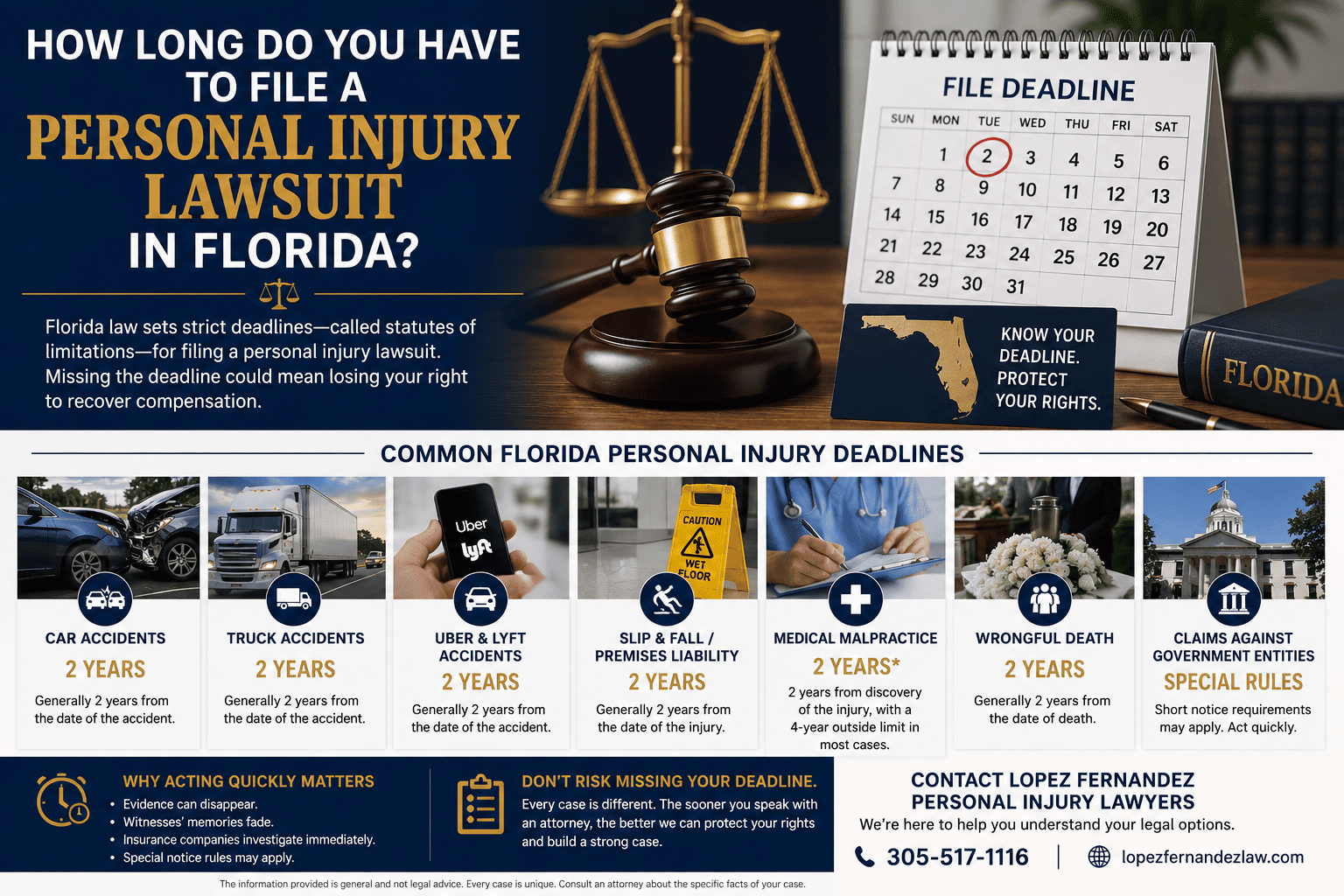
Under current Florida law, an action founded on negligence generally must be filed within two years. Many personal injury claims are based on negligence, including automobile accidents, truck accidents, rideshare collisions, slip and fall accidents, and other incidents caused by careless conduct.
The applicable period generally begins when the cause of action accrues. In many accident cases, that is the date on which the injury-producing incident occurred.
However, calculating a deadline is not always as simple as adding two years to the accident date. The correct period may depend on:
- The date the incident occurred.
- The legal theory supporting the claim.
- Whether the injury was immediately discoverable.
- Whether the defendant is a private party or government entity.
- Whether the claim involves medical malpractice.
- Whether the injured person was a minor.
- Whether a recognized tolling rule applies.
- Whether another statute establishes a different deadline.
Because Florida’s negligence filing period changed in 2023, cases arising before and after the change may be subject to different rules. An attorney should review the specific incident date rather than assuming that a general deadline applies.
Why You Should Not Wait Until the Deadline Approaches
The statute of limitations establishes the final period for filing a lawsuit, but waiting until the last moment may weaken a claim long before the legal deadline arrives.
Important evidence can disappear quickly. For example:
- Surveillance footage may be automatically erased.
- Vehicles may be repaired or destroyed.
- Accident scenes may change.
- Businesses may discard inspection records.
- Trucking companies may cycle or replace electronic data.
- Witnesses may move or become difficult to locate.
- Witness memories may become less reliable.
- Electronic communications may be deleted.
- Responsible businesses may close or reorganize.
Starting the investigation promptly allows preservation notices to be sent and important records to be requested before they are lost.
Florida Car Accident Filing Deadlines
A lawsuit alleging that another driver’s negligence caused a Florida car accident will generally be subject to the limitations period for negligence actions.
Common examples of negligent driving include:
- Speeding.
- Distracted driving.
- Following too closely.
- Running a red light.
- Failing to yield.
- Making an unsafe lane change.
- Driving while impaired.
- Operating an unsafe vehicle.
Although a lawsuit may not need to be filed immediately, the crash should be reported promptly and the injured person should obtain appropriate medical treatment.
Insurance policies may also contain reporting, cooperation, or notice requirements that operate separately from the statute of limitations.
Learn more about your legal options after a collision by visiting our Florida car accident lawyer page or our broader auto accident practice page.
Truck Accident Filing Deadlines
Commercial truck accident claims may also be subject to Florida’s negligence filing deadline, but these cases often require a more extensive investigation.
Potential defendants may include:
- The truck driver.
- The trucking company.
- The owner of the commercial vehicle.
- A maintenance provider.
- A freight broker.
- A cargo-loading company.
- A vehicle or parts manufacturer.
Evidence in a truck accident case may include:
- Electronic logging device data.
- Engine control module information.
- Driver qualification records.
- Inspection and maintenance reports.
- Dispatch communications.
- Employment and training records.
- Drug and alcohol testing records.
- Cargo-loading documents.
- Dash-camera recordings.
Some records may be overwritten or discarded during ordinary business operations. Prompt legal action can help preserve this evidence.
Visit our Florida truck accident lawyer page for more information.
Uber and Lyft Accident Filing Deadlines
Rideshare accident claims may involve several insurance policies and multiple potentially responsible parties.
The available coverage may depend on whether the driver was:
- Logged out of the rideshare application.
- Logged in and waiting for a request.
- Traveling to pick up an accepted passenger.
- Actively transporting a passenger.
The applicable statute of limitations may resemble the deadline for other negligence claims, but the rideshare company’s application data should be preserved as quickly as possible.
Relevant records may include:
- Driver application status.
- Trip acceptance timestamps.
- GPS and route data.
- Pickup and destination information.
- Electronic receipts.
- Messages between the passenger and driver.
- Communications with the rideshare company.
Learn more from our Miami Uber and Lyft accident lawyers.
Slip and Fall Filing Deadlines
A slip and fall claim may arise when a property owner, business, landlord, or other responsible party fails to address an unreasonably dangerous condition.
Potential hazards may include:
- Wet or slippery floors.
- Uneven pavement.
- Broken stairs.
- Loose carpeting.
- Inadequate lighting.
- Unmarked elevation changes.
- Missing handrails.
- Debris in a walkway.
These cases are often based on negligence and may therefore be governed by the general negligence limitations period. However, waiting can make it more difficult to prove that the dangerous condition existed.
A business may clean the floor, repair the defect, discard inspection logs, or overwrite surveillance footage soon after the incident.
Evidence should be preserved through:
- Photographs and videos of the hazard.
- Witness contact information.
- An incident report.
- Surveillance recordings.
- Inspection and maintenance records.
- Prior complaints about the condition.
- Medical records documenting the injuries.
Read more about Florida slip and fall claims and premises liability cases.
Medical Malpractice Filing Deadlines
Medical malpractice claims are governed by special rules that differ from ordinary negligence cases.
Under Florida law, a medical malpractice action generally must be commenced within two years from the incident or within two years from the time the incident was discovered, or should have been discovered through reasonable diligence.
Florida law also establishes an outside four-year period in many medical malpractice cases, although exceptions may apply, including certain claims involving minors and cases involving fraud, concealment, or intentional misrepresentation.
Medical malpractice cases are also subject to mandatory presuit requirements. Before filing a lawsuit, a claimant may need to:
- Obtain relevant medical records.
- Conduct a reasonable investigation.
- Have the claim reviewed by an appropriate medical expert.
- Obtain a written expert opinion when required.
- Send presuit notice to prospective defendants.
- Participate in a statutory presuit screening period.
Because these steps must generally be completed before the case proceeds in court, an injured patient should not wait until the limitations deadline is approaching.
Learn more by visiting our Florida medical malpractice attorney page.
Wrongful Death Filing Deadlines
A wrongful death claim may arise when a person’s death is caused by another party’s negligent or wrongful conduct.
Under current Florida law, a wrongful death action generally must be filed within two years. The period commonly runs from the date of death, although the exact analysis may depend on the circumstances and legal basis of the claim.
A wrongful death action may result from:
- A fatal car accident.
- A commercial truck collision.
- A rideshare accident.
- Medical negligence.
- Unsafe property conditions.
- A defective product.
- Another negligent or wrongful act.
Wrongful death cases involving medical malpractice may also be subject to medical-negligence presuit procedures and specialized timing rules.
Visit our Florida wrongful death lawyer page for additional information.
Claims Against Government Entities
Claims involving Florida governmental entities may be subject to special rules beyond the ordinary statute of limitations.
Potential government defendants may include:
- The State of Florida.
- A state agency.
- A county.
- A municipality.
- A public transportation authority.
- A public hospital.
- A school board.
- Another governmental subdivision.
A claim may arise from:
- A collision involving a government vehicle.
- An injury on public property.
- A dangerous public roadway.
- Negligence by a public employee.
- Medical care provided at a public facility.
Florida’s sovereign-immunity statute may require written notice to specified government parties before a lawsuit can proceed. Additional investigation periods, damage limitations, and procedural conditions may also apply.
These requirements can affect when and how the case must be presented. An injured person should seek legal guidance promptly rather than relying only on the general negligence deadline.
Does Filing an Insurance Claim Protect the Lawsuit Deadline?
Not necessarily. Reporting an accident or submitting an insurance claim generally does not replace the requirement to file a lawsuit before the applicable statute of limitations expires.
The following actions may not, by themselves, preserve your right to sue:
- Reporting the accident to an insurer.
- Exchanging settlement offers.
- Sending medical records to an adjuster.
- Participating in negotiations.
- Receiving partial payment.
- Waiting for the insurer to make a final decision.
- Receiving verbal assurances from an adjuster.
An insurance company may continue discussing a claim while the legal deadline approaches. Unless a recognized rule or written agreement changes the deadline, negotiations should not be assumed to stop the limitations period.
Can Settlement Negotiations Extend the Deadline?
Settlement negotiations generally should not be assumed to extend the statute of limitations. The parties may continue communicating, but the injured person must still protect the right to file a lawsuit.
An adjuster may request additional documents, medical authorizations, bills, wage records, or evaluations. These requests do not necessarily change the court filing deadline.
Before relying on any promise that additional time is available, obtain legal advice and confirm the effect of any written agreement.
Can the Statute of Limitations Be Paused?
In limited circumstances, Florida law may toll, or temporarily pause, the running of a statute of limitations.
Possible tolling circumstances may include:
- The defendant’s use of an unknown false name that prevents service.
- The defendant’s concealment to avoid service.
- Certain forms of adjudicated incapacity.
- Certain circumstances involving a minor without an appropriate representative.
- The pendency of an applicable arbitration proceeding.
- Other circumstances specifically recognized by Florida law.
Tolling rules are narrow and fact-specific. An injured person should not assume that being unable to locate a defendant, continuing treatment, or negotiating with an insurer automatically pauses the deadline.
Do Minors Have a Different Filing Deadline?
Claims involving injured children may be subject to special rules. The child’s age, type of claim, existence of a parent or guardian, medical-malpractice provisions, and other circumstances may affect the deadline.
Parents and guardians should not assume that every claim remains open until the child reaches adulthood. Some statutes establish outside deadlines even when the injured person is a minor.
Prompt review is important when a child is injured in:
- A motor vehicle collision.
- A school or daycare incident.
- A swimming pool accident.
- A dangerous property condition.
- A medical malpractice incident.
- An accident involving a defective product.
What Happens if You Miss the Filing Deadline?
If a lawsuit is filed after the applicable statute of limitations expires, the defendant may ask the court to dismiss the case as untimely.
If the court agrees, the injured person may lose the ability to pursue compensation through that lawsuit, regardless of:
- The seriousness of the injuries.
- The amount of medical expenses.
- The clarity of the other party’s fault.
- The effect of the injury on employment.
- The existence of insurance coverage.
- The strength of available evidence.
For this reason, confirming the correct deadline should be one of the first steps in evaluating a personal injury claim.
Evidence That Should Be Preserved Immediately
The evidence required will depend on the type of accident, but injured people should preserve as much information as reasonably possible.
Useful evidence may include:
- Police or incident reports.
- Photographs of the accident scene.
- Videos of vehicles or property conditions.
- Witness contact information.
- Surveillance-camera locations.
- Medical records and bills.
- Prescription receipts.
- Employment and wage records.
- Insurance correspondence.
- Vehicle repair estimates.
- Electronic messages and emails.
- Receipts for accident-related expenses.
Steps to Protect Your Florida Personal Injury Claim
Obtain Medical Attention
Seek appropriate medical treatment as soon as possible. Prompt care protects your health and creates documentation of your injuries and symptoms.
Report the Incident
Report a motor vehicle accident to law enforcement when required. Report a fall or other property-related injury to the owner, manager, or responsible employee.
Document the Scene
Take photographs and videos before vehicles, hazards, debris, or other conditions are changed.
Collect Witness Information
Obtain the names and contact details of people who saw the incident or the dangerous condition.
Preserve Records
Keep medical bills, insurance letters, wage statements, receipts, photographs, reports, and electronic communications in one organized file.
Avoid Signing a Release Too Quickly
Do not sign a settlement release until you understand the nature of your injuries, future medical needs, and the rights being waived.
Confirm the Filing Deadline
Have the deadline reviewed based on the specific accident date, claim type, defendant, and applicable Florida law.
How Lopez Fernandez Personal Injury Lawyers Can Help
Determining the correct filing deadline is only one part of a personal injury case. The claim must also be investigated, supported with evidence, valued appropriately, and presented to the responsible parties and insurers.
Our legal team may help by:
- Reviewing how and when the injury occurred.
- Identifying the applicable statute of limitations.
- Determining whether special notice rules apply.
- Obtaining police and incident reports.
- Preserving surveillance and electronic evidence.
- Locating and interviewing witnesses.
- Reviewing insurance policies.
- Documenting medical expenses and lost income.
- Communicating with insurance adjusters.
- Negotiating for appropriate compensation.
- Filing a lawsuit before the applicable deadline when necessary.
Personal Injury Cases We Handle
- Car accident claims
- Auto accident claims
- Commercial truck accidents
- Uber and Lyft accidents
- Slip and fall accidents
- Premises liability claims
- Medical malpractice claims
- Wrongful death claims
Frequently Asked Questions
What is the general statute of limitations for personal injury cases in Florida?
Under current Florida law, an action founded on negligence generally must be filed within two years. However, a different deadline may apply depending on the accident date, type of claim, defendant, and other circumstances.
Did Florida’s personal injury filing deadline change?
Yes. Florida changed the general limitations period for negligence actions in 2023. Claims arising before the effective date of that change may require a different analysis than claims arising afterward.
When does the two-year period begin?
In many accident cases, the period begins on the date the incident occurred. Medical malpractice, delayed-discovery cases, and other specialized claims may follow different accrual rules.
Does filing an insurance claim stop the deadline?
Filing an insurance claim generally should not be assumed to stop the statute of limitations. The court filing deadline must be protected separately.
Will settlement negotiations extend the deadline?
Settlement discussions generally do not automatically extend the filing period. A lawsuit may still need to be filed while negotiations are ongoing.
How long do I have to file a wrongful death lawsuit?
A Florida wrongful death action generally must be commenced within two years. Special circumstances may affect the analysis, particularly when medical malpractice or a government entity is involved.
How long do I have to file a medical malpractice claim?
Florida medical malpractice claims generally have a two-year discovery-based period and an outside four-year period in many cases. Exceptions and mandatory presuit procedures may apply.
What if I was injured by a government employee?
Claims against government entities may require special written notice and compliance with Florida’s sovereign-immunity statute. These requirements should be reviewed promptly.
Can the deadline be extended because I am still receiving treatment?
Continuing medical treatment does not necessarily extend the statute of limitations. The deadline may continue running while treatment is ongoing.
What if I did not immediately know I was injured?
The effect of delayed discovery depends on the type of claim and the applicable statute. Do not assume that the deadline begins only when symptoms become severe.
Do children have more time to file?
Special rules may apply to claims involving minors, but parents should not assume that every case remains open until adulthood. Some claims have outside deadlines.
What should I do if the deadline is approaching?
Contact a personal injury attorney immediately. The lawyer will need time to review the facts, identify the defendants, investigate the claim, and prepare any necessary court documents.
Contact Lopez Fernandez Personal Injury Lawyers
If you were injured because of another party’s negligence, do not wait until the filing deadline is approaching. Lopez Fernandez Personal Injury Lawyers can review your case, explain the deadlines that may apply, preserve important evidence, and help you pursue compensation from the responsible parties.
Schedule a Consultation Call 305-517-1116