A serious accident can affect nearly every part of your life. In addition to physical pain, you may face medical bills, missed work, reduced income, emotional distress, and uncertainty about your future.
If another person, business, healthcare provider, or property owner caused your injuries through negligence, you may be entitled to seek compensation through a Florida personal injury claim.
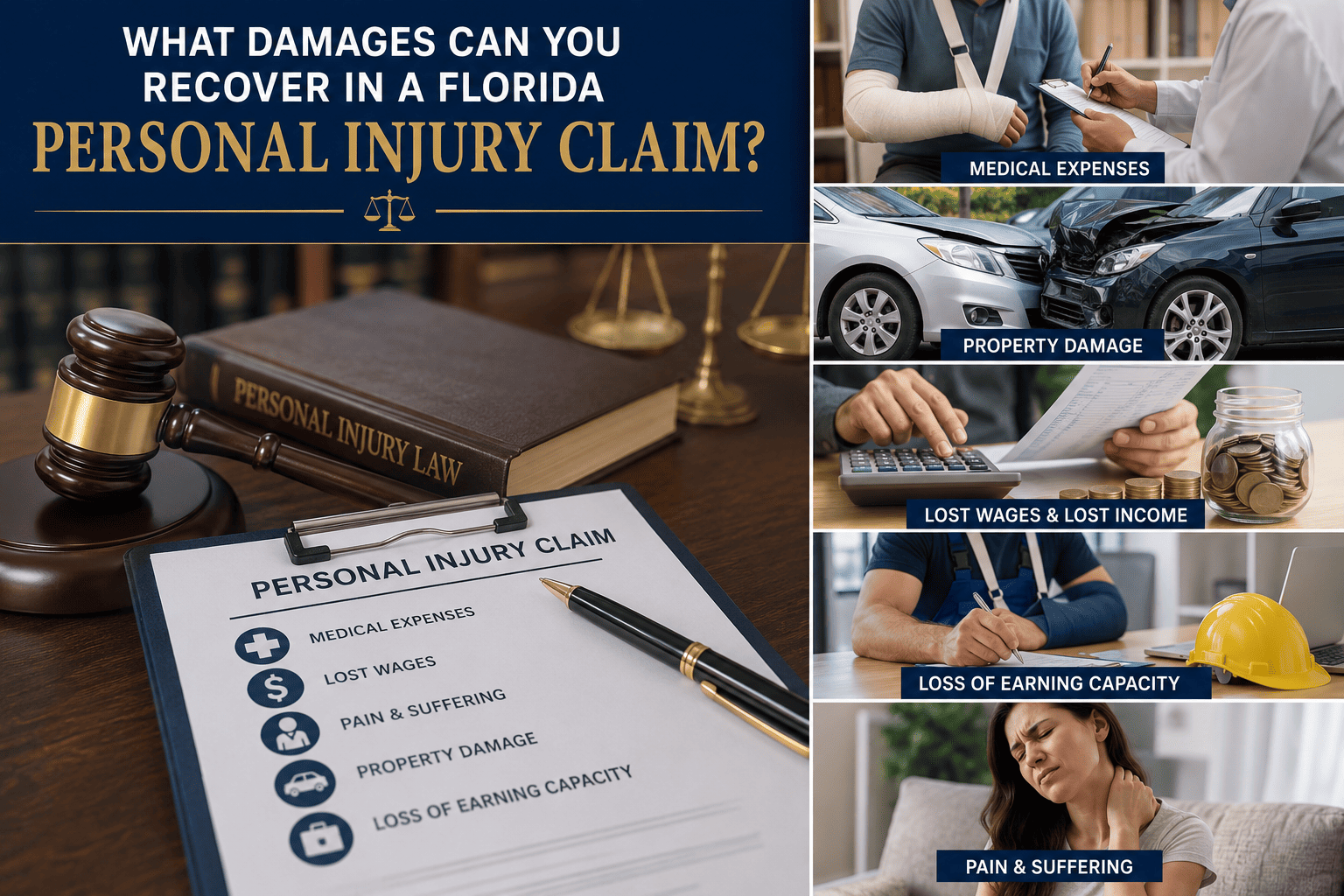
The compensation available is commonly divided into economic damages, noneconomic damages, and, in limited cases, punitive damages. The value of a claim depends on the specific facts, the severity of the injuries, available insurance coverage, and the evidence connecting the defendant’s conduct to your losses.
An experienced Florida personal injury lawyer can evaluate your case, document your damages, and help you pursue appropriate compensation from the responsible parties.
What Are Damages in a Personal Injury Case?
In a personal injury case, the term “damages” refers to the financial compensation an injured person may seek for losses caused by another party’s wrongful or negligent conduct.
Damages may be intended to compensate for:
- Medical treatment.
- Lost income.
- Future healthcare needs.
- Reduced earning ability.
- Physical pain.
- Emotional distress.
- Permanent disability.
- Property damage.
- Loss of enjoyment of life.
Florida law generally separates compensatory damages into economic and noneconomic categories. Punitive damages serve a different purpose and are available only in limited circumstances.
Economic Damages
Economic damages compensate an injured person for measurable financial losses. These losses can usually be supported with bills, receipts, employment records, tax documents, expert reports, and other financial evidence.
Florida law defines economic damages to include losses such as past and future lost income, medical and funeral expenses, lost support and services, property losses, repair costs, and other economic losses caused by the injury.
Past Medical Expenses
You may be able to seek compensation for reasonable medical expenses resulting from the accident.
Past medical expenses may include:
- Ambulance transportation.
- Emergency room treatment.
- Hospital stays.
- Doctor appointments.
- Diagnostic testing.
- Surgery.
- Prescription medication.
- Physical therapy.
- Occupational therapy.
- Medical equipment.
- Home healthcare services.
Keep copies of every bill, explanation of benefits, receipt, prescription record, and medical statement related to the injury.
Future Medical Expenses
Some injuries require treatment long after a claim is resolved. Future medical damages may be available when evidence shows that ongoing care will probably be necessary.
Future treatment may include:
- Additional surgery.
- Specialist appointments.
- Rehabilitation.
- Physical therapy.
- Pain-management treatment.
- Prescription medication.
- Prosthetic devices.
- Mobility equipment.
- Home nursing assistance.
- Long-term residential care.
Doctors, rehabilitation specialists, life-care planners, and economists may help estimate the expected cost of future care.
Lost Wages
If your injuries prevented you from working, you may be able to recover income lost during your recovery.
Evidence of lost wages may include:
- Pay stubs.
- Employer verification letters.
- Work schedules.
- Tax returns.
- Bank statements.
- Disability records.
- Medical work restrictions.
Lost-income damages may apply even when you used sick leave, vacation time, or paid time off because of the injury.
Loss of Future Earning Capacity
A serious injury may reduce your ability to earn income in the future. This loss is different from wages already missed.
Loss of earning capacity may arise when an injury causes:
- Permanent physical restrictions.
- Inability to return to the same occupation.
- Reduced working hours.
- Loss of professional licenses or qualifications.
- Difficulty completing physical job duties.
- Cognitive or memory limitations.
- Reduced opportunities for promotion.
- Early retirement from the workforce.
Vocational experts and economists may evaluate your education, employment history, skills, age, medical limitations, and expected career path.
Property Damage
When an accident damages a vehicle or other personal property, compensation may be available for repair or replacement costs.
Property-related losses may include:
- Vehicle repairs.
- Vehicle replacement value.
- Towing expenses.
- Storage fees.
- Rental vehicle costs.
- Damaged electronics.
- Damaged clothing or personal belongings.
Photographs, repair estimates, receipts, valuation reports, and ownership records can help establish these losses.
Out-of-Pocket Expenses
An injury may create additional expenses that are not included in standard medical bills.
Examples may include:
- Transportation to medical appointments.
- Parking fees.
- Childcare expenses.
- Housekeeping assistance.
- Home modifications.
- Wheelchair ramps.
- Vehicle modifications.
- Medical supplies.
- Travel for specialist treatment.
Save receipts and maintain a written record of every injury-related expense.
Noneconomic Damages
Noneconomic damages compensate an injured person for losses that do not have a fixed financial price. These damages reflect the human effect of an injury rather than a specific bill or receipt.
Noneconomic damages may include:
- Physical pain and suffering.
- Emotional distress.
- Mental anguish.
- Loss of enjoyment of life.
- Permanent disability.
- Scarring or disfigurement.
- Loss of companionship.
- Loss of consortium.
Pain and Suffering
Pain-and-suffering damages may compensate for the physical discomfort caused by an injury and medical treatment.
Factors that may affect these damages include:
- The severity of the injury.
- The duration of the pain.
- The invasiveness of medical treatment.
- The need for surgery.
- The likelihood of future pain.
- The effect on sleep and mobility.
- The impact on daily activities.
Emotional Distress and Mental Anguish
Accidents can cause emotional and psychological injuries in addition to physical harm.
An injured person may experience:
- Anxiety.
- Depression.
- Fear of driving.
- Post-traumatic stress symptoms.
- Sleep disturbances.
- Nightmares.
- Embarrassment.
- Social withdrawal.
Treatment records from therapists, psychologists, psychiatrists, and other healthcare providers may help document these effects.
Loss of Enjoyment of Life
An injury may prevent you from participating in activities that were important before the accident.
Examples may include difficulty or inability to:
- Exercise.
- Play sports.
- Travel.
- Care for children.
- Attend social events.
- Participate in hobbies.
- Complete household tasks.
- Maintain personal relationships.
Permanent Disability
Catastrophic injuries may create permanent physical, neurological, or cognitive limitations.
Permanent disabilities may involve:
- Paralysis.
- Amputation.
- Traumatic brain injury.
- Spinal cord damage.
- Loss of vision or hearing.
- Chronic pain.
- Reduced mobility.
- Permanent cognitive impairment.
Medical experts may assess the degree of impairment and explain how the disability is expected to affect the injured person over time.
Scarring and Disfigurement
Visible scars, burns, amputations, and other permanent changes in appearance can cause both physical and emotional harm.
The effect of disfigurement may depend on:
- The location of the scar.
- The size and visibility of the injury.
- The injured person’s age.
- The need for reconstructive treatment.
- The effect on employment.
- The effect on confidence and social activities.
Loss of Consortium
In some cases, the spouse of an injured person may have a claim for the loss of companionship, affection, assistance, and marital relationship caused by the injury.
These claims are highly fact-specific and depend on the nature of the relationship and the effects of the injury.
What Are Compensatory Damages?
Compensatory damages are intended to compensate an injured person for losses caused by the defendant’s conduct.
They generally include:
- Economic damages.
- Noneconomic damages.
Compensatory damages differ from punitive damages, which are intended to punish particularly wrongful conduct rather than reimburse a specific loss.
Can You Recover Punitive Damages?
Punitive damages are not available in every Florida personal injury case. They may be considered only when the evidence supports a substantially higher level of wrongdoing than ordinary carelessness.
Under Florida law, a defendant may be held liable for punitive damages when clear and convincing evidence establishes intentional misconduct or gross negligence. Gross negligence generally involves conduct so reckless or lacking in care that it demonstrates a conscious disregard or indifference to the safety or rights of others.
Possible situations that may justify investigating punitive damages include:
- A highly intoxicated driver causing a serious collision.
- A company knowingly ignoring an extreme safety risk.
- A trucking company repeatedly allowing dangerous violations.
- Intentional destruction or concealment of critical safety evidence.
- A defendant knowingly continuing conduct likely to cause serious injury.
A plaintiff generally cannot include a punitive-damages claim without first presenting evidence that provides a reasonable basis for it. Florida also applies special proof requirements and statutory limitations to punitive awards.
How Is a Florida Personal Injury Claim Valued?
There is no standard settlement amount for a personal injury claim. Two people involved in similar accidents may recover different amounts because their injuries, treatment, employment, insurance coverage, and long-term outcomes are different.
Factors that may affect the value of a claim include:
- The severity of the injuries.
- The length of medical treatment.
- The need for surgery.
- Whether the injury is permanent.
- The amount of past medical expenses.
- The cost of future medical care.
- Lost wages and reduced earning capacity.
- The effect on daily activities.
- The strength of the liability evidence.
- The percentage of fault assigned to each party.
- The amount of available insurance coverage.
- The credibility and consistency of the evidence.
How Comparative Fault Can Affect Compensation
Florida applies comparative-fault rules in negligence actions. This means an injured person’s compensation may be reduced when that person is found partly responsible for the incident.
For example, if the total damages were determined to be $100,000 and the injured person was found 20 percent responsible, the award could be reduced according to that percentage.
Under Florida’s current modified comparative-fault rule, a claimant found more than 50 percent responsible for their own harm generally cannot recover damages in a negligence action, subject to statutory exceptions. A claimant who is 50 percent or less at fault may have compensation reduced in proportion to the assigned percentage of fault.
Insurance companies may attempt to shift blame by alleging that an injured person:
- Was speeding.
- Was distracted.
- Failed to observe a warning.
- Wore unsafe footwear.
- Ignored medical instructions.
- Delayed seeking treatment.
- Contributed to the accident in another way.
Photographs, witness statements, reports, video recordings, expert analysis, and medical documentation may help challenge unsupported fault allegations.
How Insurance Coverage Affects Recovery
The amount of available insurance may significantly affect the practical recovery in a personal injury case.
Potential sources of coverage may include:
- Automobile liability insurance.
- Commercial vehicle insurance.
- Rideshare insurance.
- Uninsured motorist coverage.
- Underinsured motorist coverage.
- Homeowners insurance.
- Business liability insurance.
- Premises liability insurance.
- Umbrella insurance.
- Professional liability insurance.
Multiple policies may apply when several parties contributed to an accident.
Damages After a Car Accident
A person injured in a car accident may seek compensation for medical expenses, lost wages, future treatment, vehicle damage, pain and suffering, and other losses.
Important evidence may include:
- The police crash report.
- Photographs of the vehicles.
- Dash-camera footage.
- Witness statements.
- Medical records.
- Repair estimates.
- Employment records.
- Insurance policy information.
Learn more by visiting our Florida car accident lawyer and auto accident pages.
Damages After a Truck Accident
Commercial truck accidents often cause catastrophic injuries and substantial financial losses.
A truck accident claim may include compensation for:
- Emergency medical treatment.
- Multiple surgeries.
- Long-term rehabilitation.
- Permanent disability.
- Lost earning capacity.
- Home modifications.
- Mobility devices.
- Long-term nursing care.
- Pain and suffering.
Several parties may share responsibility, including the driver, trucking company, vehicle owner, cargo loader, maintenance provider, or manufacturer.
Visit our Florida truck accident lawyer page for more information.
Damages After an Uber or Lyft Accident
Rideshare accident compensation may depend on the driver’s application status, the cause of the collision, and the insurance policies available.
A rideshare claim may involve:
- The rideshare driver’s insurance.
- Insurance connected with the Uber or Lyft trip.
- Another driver’s liability insurance.
- Uninsured or underinsured motorist coverage.
- The injured person’s applicable insurance benefits.
Learn more from our Miami Uber and Lyft accident lawyers.
Damages After a Slip and Fall Accident
A serious fall may cause broken bones, head injuries, spinal injuries, torn ligaments, and other conditions requiring extended treatment.
Potential compensation may include:
- Medical expenses.
- Physical therapy.
- Lost income.
- Future medical care.
- Pain and suffering.
- Permanent limitations.
- Out-of-pocket expenses.
Read more about Florida slip and fall accidents and premises liability claims.
Damages in a Medical Malpractice Claim
Medical malpractice can result in additional treatment, permanent disability, reduced life expectancy, lost income, and significant emotional distress.
Potential damages may include:
- Corrective medical treatment.
- Future healthcare expenses.
- Lost wages.
- Loss of earning capacity.
- Rehabilitation.
- Home healthcare.
- Pain and suffering.
- Permanent disability.
Medical malpractice claims are subject to special Florida procedures and deadlines. Learn more from our Florida medical malpractice attorney page.
Damages in a Wrongful Death Claim
When negligence results in death, Florida law permits certain survivors and the decedent’s estate to pursue specified damages through a wrongful death action.
Depending on the circumstances and the survivor’s relationship to the deceased person, damages may include:
- Lost support and services.
- Medical expenses.
- Funeral expenses.
- Loss of companionship and protection.
- Mental pain and suffering.
- Losses suffered by the estate.
The damages available are governed by Florida’s Wrongful Death Act and depend on the identities and relationships of the surviving family members.
Visit our Florida wrongful death claims page for additional information.
What Evidence Helps Prove Damages?
A personal injury claim must be supported with evidence showing both how the accident occurred and how it affected the injured person.
Helpful documentation may include:
- Medical records.
- Medical bills.
- Prescription receipts.
- Diagnostic images.
- Photographs of injuries.
- Employment records.
- Tax returns.
- Expert reports.
- Vehicle repair estimates.
- Receipts for out-of-pocket expenses.
- Personal journals describing symptoms and limitations.
- Statements from family members, coworkers, and witnesses.
Why Medical Treatment Is Important
Prompt and consistent medical care is important for both your health and your legal claim.
Medical records can help establish:
- The nature of the injury.
- When symptoms began.
- The treatment provided.
- Whether the injury is permanent.
- Future medical needs.
- Work and activity restrictions.
Unexplained gaps in treatment may allow an insurance company to argue that the injury was minor, unrelated to the accident, or resolved earlier than claimed.
Should You Accept the Insurance Company’s First Offer?
An early settlement offer may be made before you know the full extent of your injuries and future medical needs.
Before accepting an offer, consider whether it includes:
- All current medical expenses.
- Expected future treatment.
- Lost wages.
- Reduced earning capacity.
- Pain and suffering.
- Permanent limitations.
- Other out-of-pocket losses.
Once a settlement release is signed, you generally cannot seek additional compensation from the released parties if your condition later worsens.
How Lopez Fernandez Personal Injury Lawyers Can Help
Calculating damages requires more than adding medical bills. A complete evaluation should consider the injury’s effect on your health, employment, independence, family, and future.
Our legal team may help by:
- Investigating the accident.
- Identifying responsible parties.
- Reviewing available insurance policies.
- Obtaining medical records and bills.
- Documenting lost income.
- Evaluating future medical needs.
- Consulting with medical and financial experts.
- Calculating economic and noneconomic losses.
- Responding to comparative-fault allegations.
- Negotiating with insurance companies.
- Preparing a lawsuit when necessary.
Personal Injury Cases We Handle
- Car accident claims
- Auto accident claims
- Commercial truck accidents
- Uber and Lyft accidents
- Slip and fall accidents
- Premises liability claims
- Medical malpractice claims
- Wrongful death claims
Frequently Asked Questions
What damages can I recover in a Florida personal injury claim?
Depending on the case, compensation may include medical expenses, future treatment, lost wages, reduced earning capacity, property damage, pain and suffering, emotional distress, disability, and other losses.
What is the difference between economic and noneconomic damages?
Economic damages compensate for measurable financial losses such as medical bills and lost wages. Noneconomic damages compensate for personal harm such as pain, emotional distress, and loss of enjoyment of life.
Can I recover future medical expenses?
Future medical expenses may be available when medical evidence shows that ongoing treatment is reasonably expected because of the injury.
Can I recover compensation for pain and suffering?
Pain-and-suffering damages may be available depending on the type of case, the nature of the injuries, and applicable Florida law.
Can I recover damages if I was partly responsible?
Your compensation may be reduced according to your percentage of fault. Under Florida’s modified comparative-fault rule, a claimant found more than 50 percent responsible generally cannot recover in a negligence action, subject to statutory exceptions.
Are punitive damages available in every case?
No. Punitive damages require evidence of intentional misconduct or gross negligence and are subject to special pleading, proof, and limitation rules.
How is pain and suffering calculated?
There is no fixed formula required for every case. Relevant factors may include the severity and duration of the pain, medical treatment, permanency, daily limitations, and the effect on the injured person’s life.
Can I recover lost wages if I used paid time off?
Potentially. The use of vacation, sick leave, or other earned benefits does not necessarily mean that no wage-related loss occurred.
Can self-employed people recover lost income?
Yes, but the claim may require tax returns, invoices, contracts, business records, bank statements, and expert analysis.
How much is my personal injury case worth?
There is no standard amount. The value depends on liability, injury severity, medical treatment, future care, income losses, insurance coverage, permanency, and the quality of the supporting evidence.
Should I accept the first settlement offer?
Review the full extent of your injuries and losses before signing a release. An early offer may not account for future treatment, lost earning capacity, or permanent limitations.
How can an attorney help document damages?
An attorney can collect records, consult with experts, identify insurance coverage, calculate financial losses, document noneconomic harm, and negotiate with the responsible parties and insurers.
Contact Lopez Fernandez Personal Injury Lawyers
If you were injured because of another party’s negligence, Lopez Fernandez Personal Injury Lawyers can evaluate your losses, identify the available insurance coverage, and help you seek compensation from the responsible parties.
Schedule a Consultation Call 305-517-1116